Phantom Code
A desktop app that turns screenshots of coding problems into solutions, sold as source code
- Automated tests
- 324
- Documentation pages
- 17
- Desktop platforms
- 2
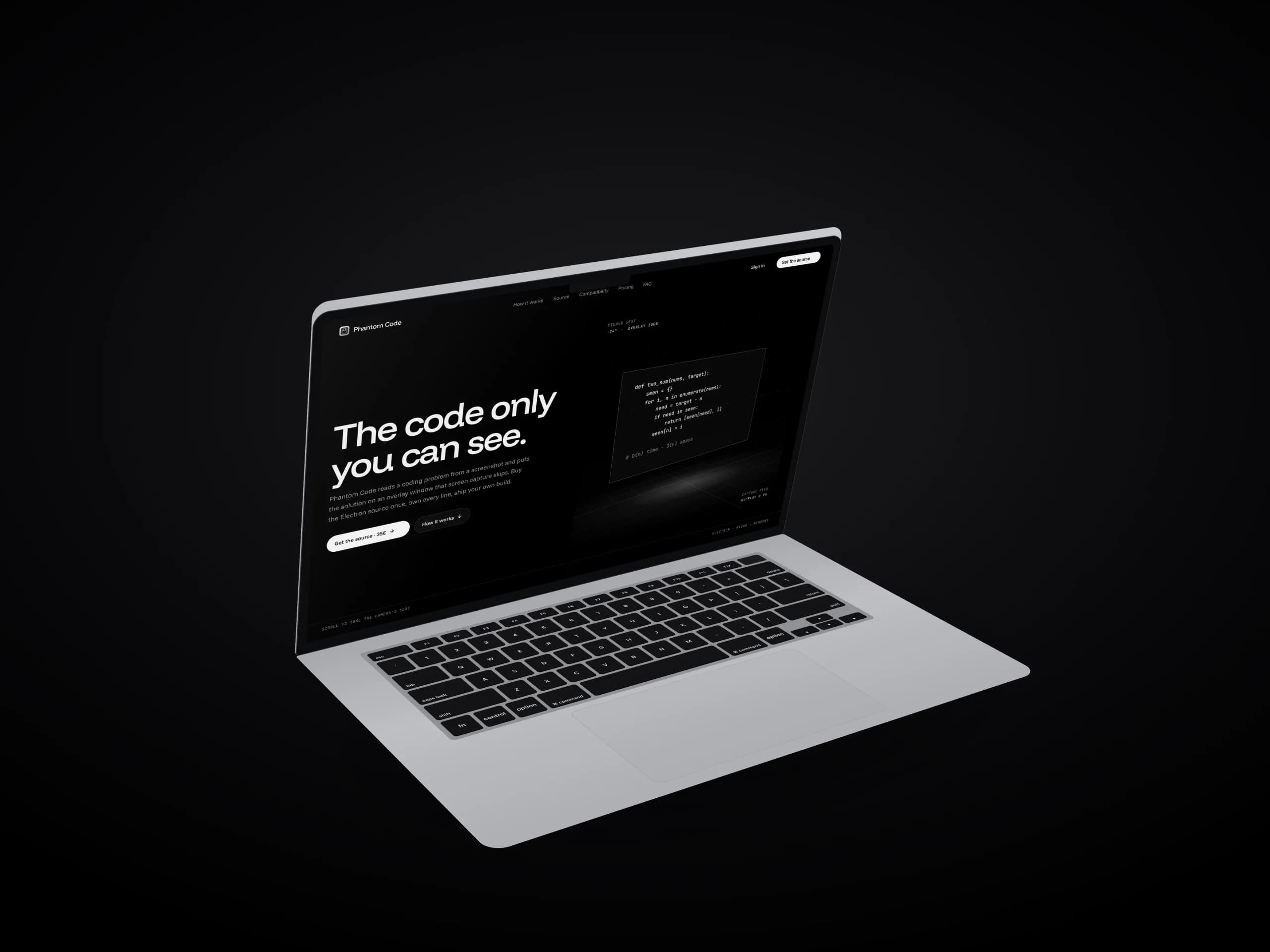
Phantom Code is a desktop app built with Electron and React. A global shortcut captures the problem on screen and a NestJS API sends the screenshot to the model the user picks: OpenAI, Anthropic, Google Gemini or OpenRouter through the Vercel AI SDK, with Tesseract OCR as a fallback, or a local model through Ollama or LM Studio. The solution appears in an overlay window. API keys are stored per provider and encrypted with the operating system's keystore.
The product is the source code itself. The Next.js 16 site sells lifetime access through Stripe, signs buyers in with Better Auth, gates a 17-page Markdown documentation set stored in PostgreSQL with live section-level search, and serves time-limited downloads from Supabase Storage that GitHub Actions rebuilds on every push.
I redesigned the whole frontend as a monochrome, dark-only system. The hero is a three.js scene built around the Pepper's ghost stage illusion: a pane of glass carrying the code on a dark stage, orbited by the camera as you scroll. The buyer console follows the structure of the Oxide Computer console, with a command palette, ruled tables and loading skeletons, and 404 and error pages render their status code as a dot matrix.
The redesign also moved every dependency to its latest version, including TypeScript 7 running alongside the TypeScript 6 API for tooling, and added a Docker dev stack with a local Upstash-compatible Redis and route pre-compilation that cut the first navigation from 10.2 s to about 180 ms.